
Remote, Strange and Yet as If Close… The Imagined and Real Encounters of Czechs with First Nation Peoples | Lecture | CRASH
On Wednesday, October 14 at 6 pm we invite you to Galerie Rudolfinum for a lecture by a historian and ethnologist Markéta Křížová, which is part of the accompanying programme for the exhibition Crested/mâcistan: Tanya Lukin Linklater and Duane Linklater.
The programme is the continuation of the CRASH free series and will be held in Czech.
Admission with a valid exhibition ticket.
Remote, Strange and Yet as If Close… The Imagined and Real Encounters of Czechs with First Nation Peoples
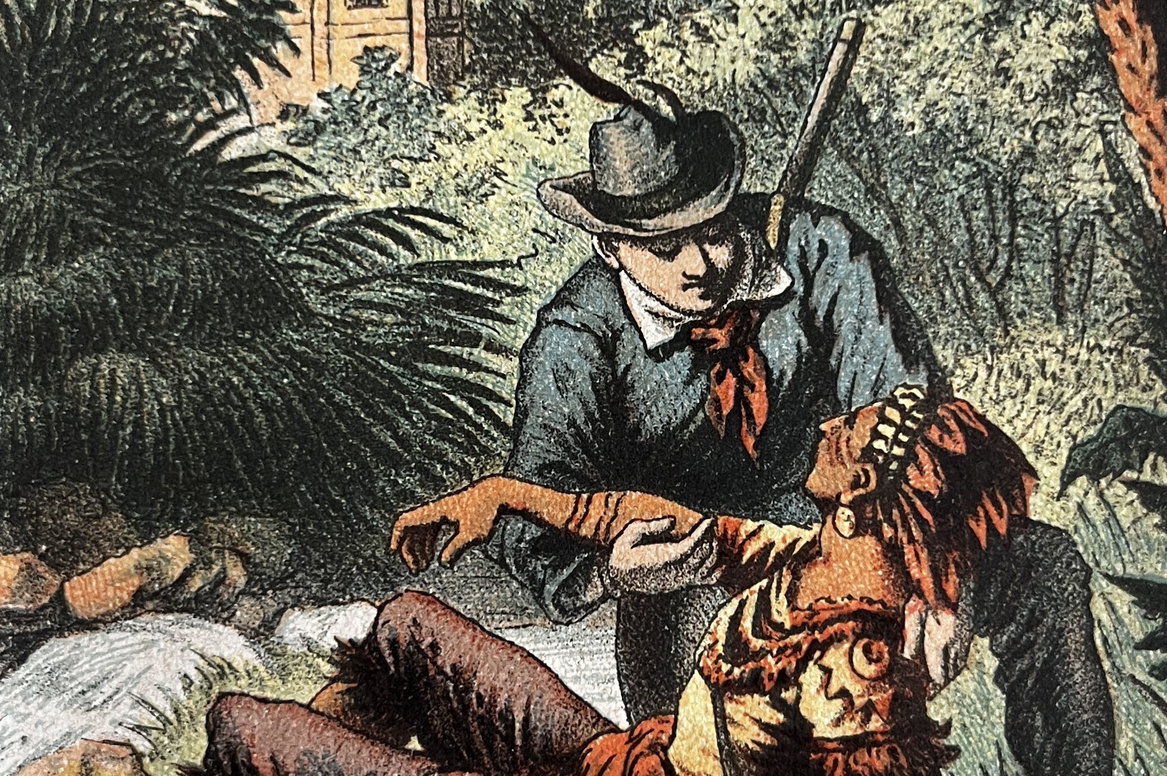
From the time of Columbus’s first voyage, the First Nation people occupied a special place in the European imagination. Unlike Africa and Asia, the continent was a true ‘New World’, an unknown place shrouded in exoticism and associated with non-European lands and peoples.
By the nineteenth century, mass immigration to the Americas meant that Czechs, increasingly resentful of their subordination within the Austro-Hungarian Empire, projected their own feelings onto Indigenous peoples who had in fact been displaced from their homeland by colonial conquest. Over the following decades, this romanticised vision of the Americas grew through Czech translations of Karl May’s novels, the popularity of Buffalo Bill Cody’s Wild West Show, and the tramping and scouting movements.
In her lecture, Professor Markéta Křížová will critically address these histories and their socialist film adaptations, which often employed ostentatious anti-colonial Soviet discourse. The lecture will demonstrate how racial and gender stereotypes were created in the portrayal of Indigenous peoples in Central European contexts.
Markéta Křížová
Markéta Křížová studied ethnology and history at the Faculty of Arts, Charles University, and is a professor at the Department of History, Faculty of Arts, Charles University. Her research focuses on the history of indigenous cultures in Latin America and the colonial and modern history of the same region, particularly the relations between indigenous peoples and Europeans and the impact of encounters with the American reality on European self-perception, as well as the history of modern utopias and the history of science.